Why Do Identical Requests Show Different Timing Drift Across Edge Nodes?
Developers often assume that identical requests to Cloudflare should produce identical response times.
After all, Cloudflare’s infrastructure is globally synchronized — hundreds of edge nodes operating under the same architecture.
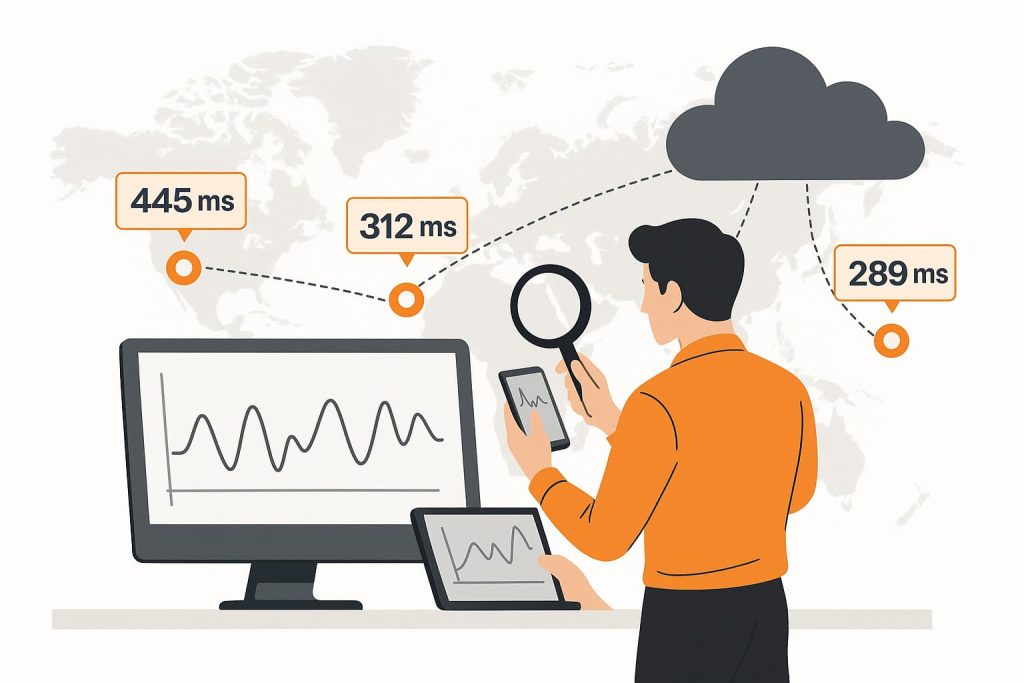
But in real-world monitoring, the same request sent to two Cloudflare regions often shows noticeable timing drift,
sometimes 100–300 milliseconds apart, even with the same payload and conditions.
Why does this happen?
The answer lies in subtle differences between edge clock synchronization, queue state, token verification cycles, and trust-layer propagation.
In this article, we’ll break down how these elements interact — and how CloudBypass API helps quantify the hidden mechanics behind timing drift.
1. The Myth of Perfect Symmetry
Cloudflare’s edge architecture is distributed, not mirrored.
Each edge node runs local models, local caches, and local trust evaluation routines.
While they share a common policy framework, their runtime state diverges constantly due to asynchronous updates and region-specific behaviors.
That means two “identical” requests might take slightly different code paths,
depending on what each edge knows at that exact moment.
2. Clock Synchronization and Skew
All Cloudflare POPs synchronize to master time via NTP-like protocols,
but even microsecond drift can accumulate under high load or regional jitter.
When combined with security token timestamp checks,
those tiny differences translate into milliseconds of delay in validation cycles.
Cloudflare compensates for skew using tolerance windows,
but the resulting micro-latency variation can still differ across edges —
especially when cryptographic revalidation aligns with local tick boundaries.
3. Queue States and Thread Allocation
Each edge node handles millions of concurrent sessions.
When identical requests arrive, they’re not always assigned the same queue depth or worker priority.
Queue contention, CPU throttling, or a brief surge in I/O tasks
can introduce transient latency drift — a difference invisible in logs but clear in metrics.
Even under identical external load,
one edge might briefly delay your request due to background garbage collection or cache eviction.
4. Token Verification Windows
Cloudflare’s trust system revalidates tokens based on rolling intervals.
If your request arrives during a verification window — even a few milliseconds before the next refresh —
that edge performs a token integrity check, adding a small delay.
Meanwhile, another edge handling the same request just after its own refresh might skip the check entirely.
The result: identical requests, non-identical trust timing.
5. Localized Entropy and Edge Behavior
Each Cloudflare POP tracks its local entropy —
the measure of unpredictability in traffic flow.
Higher entropy means more variability, which triggers slightly deeper verification.
So if one region’s background traffic is noisier than another’s,
you’ll see a higher probability of mid-layer checks.
This is why identical payloads might experience different treatment across the network.
6. Propagation Delay in Edge Updates
When Cloudflare pushes new security rules or trust model parameters,
they propagate gradually across all regions.
During that short rollout window,
one POP may run a newer behavioral model than another.
Requests verified under the updated model
could undergo extra checks,
creating temporary performance drift between nodes.
7. CloudBypass API: Measuring Hidden Timing Drift
CloudBypass API provides telemetry that reveals these timing asymmetries.
It measures:
- Average per-region latency variance
- Token verification overlap ratio
- Edge synchronization skew (ms)
- Drift correlation with entropy spikes
By mapping edge-to-edge timing divergence,
developers can understand whether observed drift is due to clock offset, revalidation timing, or local queue conditions — without violating Cloudflare’s integrity.
8. Sample Observation
| Region | Mean Latency (ms) | Timing Drift (vs baseline) | Likely Cause |
|---|---|---|---|
| Frankfurt | 110 | +8ms | Queue fluctuation |
| Singapore | 132 | +27ms | Token refresh overlap |
| São Paulo | 125 | +18ms | Clock offset |
| Los Angeles | 104 | +4ms | Stable baseline |
| Mumbai | 141 | +36ms | Local entropy surge |
This snapshot shows that no edge behaves identically,
even when the global architecture is consistent.
9. Practical Insights for Developers
You can’t eliminate timing drift — it’s part of distributed reality —
but you can interpret and design around it:
- Aggregate latency metrics over time instead of relying on single samples.
- Compare edges with similar traffic entropy levels.
- Observe revalidation intervals to identify periodic drift.
- Use CloudBypass API telemetry to correlate drift with trust-cycle timing.
The goal isn’t to “fix” drift, but to understand what drives it.
FAQ
1. Why do timing drifts vary daily?
Because edge load, revalidation cycles, and routing routes change constantly.
2. Can I force requests to always hit the same edge?
Only partially — routing is controlled by Cloudflare’s Anycast system.
3. Does higher latency mean lower trust?
Not necessarily; it may reflect edge load, not security scrutiny.
4. Can CloudBypass API detect clock skew?
Yes, it estimates relative skew by measuring response-phase alignment.
5. Are these differences permanent?
No. Drift fluctuates dynamically and usually averages out over long periods.
Identical requests diverge in timing because Cloudflare’s edges operate semi-autonomously.
Clock skew, trust revalidation, and local entropy create a rhythm of micro-delays that reflect a healthy, adaptive system.
Each edge node isn’t a clone — it’s an intelligent checkpoint with its own perception of time and risk.
With CloudBypass API ,
these invisible timing drifts become measurable phenomena,
turning mystery into data and latency into insight.
In distributed systems, perfection is impossible — but observability makes imperfection predictable.
Compliance Notice:
This article is for educational and research purposes only.