Why Do Issues Become Harder to Diagnose When Execution Paths Lack Visibility, and What Does Observability Actually Solve?
A job slows down, but nothing “fails.”
A batch finishes, but the output is missing pieces.
Retries spike, but logs look clean.
Two nodes run the same task, yet one drifts and nobody can explain why.
That is the real pain: not the issue itself, but the inability to prove where it starts.
Mini conclusion upfront:
When the execution path is invisible, every symptom looks like the root cause.
Observability turns guesswork into a timeline.
A timeline is what lets you fix the right stage instead of treating everything as “network problems.”
This article solves one specific problem:
why invisible execution paths make diagnosis harder, and what observability actually changes in day to day operations.
1. What “Lack of Visibility” Really Looks Like in Real Systems
1.1 You Only See the Start and the End
In many pipelines, you can see:
request sent
response received
status code
total latency
But you cannot see the middle.
You do not know:
where time was spent
which sub stage stalled
whether a retry happened inside a dependency call
which node path introduced jitter
which step created an ordering gap
Without the middle, diagnosis collapses into speculation.
1.2 Symptoms Become Misleading
When a system lacks visibility, teams often blame the wrong thing.
Examples:
a slow response is blamed on the target site, but it was DNS variance
a failure is blamed on a node, but it was a retry storm upstream
a partial output is blamed on parsing, but it was missing pages caused by drift
a “random” slowdown is blamed on traffic, but it was queue pressure inside the scheduler
Invisible paths create false narratives.
2. Why Problems Become Harder to Diagnose Over Time
2.1 Long Runs Hide Slow Degradation
Short tests rarely show structural decay.
Long runs expose it:
health slowly drops on specific nodes
tail latency grows
retry cost rises
ordering gaps accumulate
success rate decays gradually
If you only watch totals, you notice the decline late, when it is expensive to recover.
2.2 Parallelism Creates Many Possible Failure Points
In multi worker execution, a symptom can originate from:
one weak node
a noisy path
a congested dependency
a scheduler imbalance
a single stage backlog
Without observability, you cannot locate which lane caused the slowdown.
So teams over correct:
they reduce concurrency globally
they rotate nodes blindly
they restart jobs unnecessarily
they widen timeouts instead of fixing the bottleneck
This “fix” often makes performance worse.
3. What Observability Actually Solves, in Practical Terms
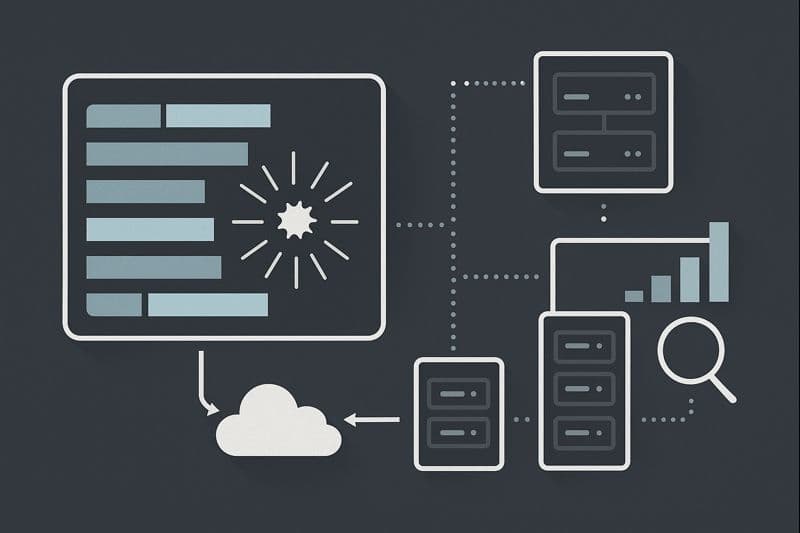
3.1 It Builds a Stage by Stage Timeline
Observability turns a request into a sequence:
DNS
connect
handshake
first byte
transfer
parse
downstream calls
retry logic
queue wait
task completion
When something slows down, you can answer:
which stage changed
when it started
how often it repeats
whether it correlates with node choice or concurrency
3.2 It Separates Root Cause From Amplifiers
A small issue becomes a large problem because of amplifiers.
Common amplifiers:
retry storms that multiply load
queue pressure that delays everything
tail latency that blocks batch completion
node oscillation that destabilizes timing
Observability shows what is root cause and what is amplification.
Without that, teams often treat amplifiers as the cause, and nothing improves.
3.3 It Makes “Normal” Measurable
Most teams do not know what normal looks like.
Observability defines baselines:
typical stage latencies
typical variance
expected retry rates
expected queue depth
normal node health range
Once baselines exist, anomalies become obvious and actionable.
4. The Most Valuable Signals to Capture
4.1 Stage Latency Breakdown
Total latency is too coarse.
You need stage latency.
Key stages:
DNS time
connect time
handshake time
first byte time
transfer time
parse time
downstream call time
queue wait time
4.2 Retry Shape and Backoff Behavior
Count alone is not enough.
You need the shape:
how quickly retries happen
whether backoff grows
whether retries cluster on a node
whether a failing route keeps receiving traffic
4.3 Node and Route Health Over Time
Observability must track drift:
timing drift per node
success rate per node
tail latency per node
stability under concurrency
This is how you detect deterioration before it becomes an outage.
4.4 Ordering and Sequencing Integrity
Many pipelines fail quietly through sequence breaks:
missing pages
out of order results
skipped cursors
partial chains
Observability must detect these, or output quality collapses silently.
5. A New User Friendly Example You Can Copy
You do not need a complicated platform to start.
A practical approach:
tag every task with a trace id
record timestamps at each stage boundary
store node id, route id, and concurrency level
record retry count plus retry spacing
alert on stage drift, not only total latency
When a slowdown happens, you can answer in minutes:
which stage moved
which node is responsible
whether retries amplified it
whether it is regional or local
This prevents blind tuning and wasted restarts.
6. Where CloudBypass API Fits Naturally
CloudBypass API is valuable in observability because many access problems are timing problems.
It helps expose:
phase by phase latency patterns
node level timing drift
route variance across regions
burst irregularities under concurrency
signals that predict instability before failures spike
Instead of treating access as a black box, teams get a measurable execution path.
That changes operations:
less guessing
fewer blanket reductions in concurrency
faster isolation of unhealthy routes
more stable long running performance
Issues become harder to diagnose when execution paths lack visibility because you cannot build a timeline.
Without a timeline, symptoms masquerade as causes, and fixes become random experiments.
Observability solves this by turning work into measurable stages, defining baselines, and separating root causes from amplifiers.
Once you can see the path, stability becomes an engineering problem, not a guessing game.