Is There a Practical Ceiling to Service Stability, and How Do Systems Usually Hit Their Limits?
A service feels rock-solid for weeks, then it starts to wobble in a way that is hard to pin down.
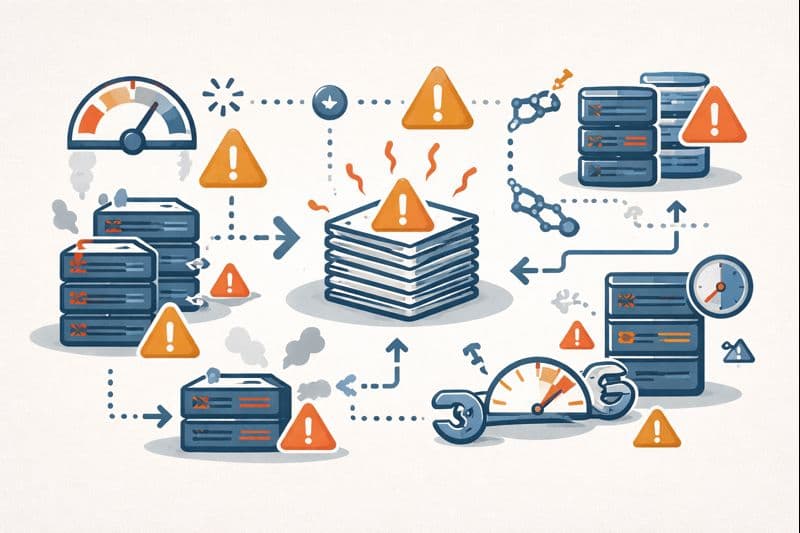
Nothing is fully down, but queues grow longer, retries become routine, and the system needs more babysitting to achieve the same results. Scaling helps briefly, tuning buys a little time, and then the slide resumes. This is the stability ceiling revealing itself.
Mini conclusion up front:
Yes, most services have a practical stability ceiling under their current design and operating habits.
Systems usually reach that ceiling through cumulative variance, not sudden collapse.
The ceiling rises only when tails, retries, and feedback loops are controlled, not when raw capacity is added.
This article focuses on one problem only: what stability ceilings look like in real systems, why they are reached, and how to raise the ceiling without turning the service into a fragile, over-tuned machine.
1. Stability Has a Ceiling Because Variance Has a Ceiling
1.1 Why Uptime Is a Misleading Stability Metric
Many teams define stability as uptime.
That definition is too forgiving.
In automated access systems and long-running services, stability means predictable completion under changing conditions. A system can be technically up while behaving inconsistently run to run.
The first limiter is variance:
- tail latency grows
- node performance spreads
- success rates diverge across paths
- identical workloads finish at wildly different times
A system reaches its ceiling when variance becomes large enough that small disturbances create outsized operational pain.
1.2 Early Warning Rule Newcomers Can Copy
Track tails and variance, not only averages.
If tail latency keeps growing for a week, the system is already pressing against its stability ceiling.
2. How Systems Usually Hit Their Stability Limits
2.1 Retry Load Quietly Becomes the Main Traffic
Most systems do not fail because primary traffic explodes.
They fail because retries quietly become the dominant workload.
Early stage:
Retries are rare and feel harmless.
Late stage:
Retries are constant background noise.
At that point, the system fights itself:
- queues lengthen
- timeouts increase
- retries multiply
- load grows again
This loop turns a stable service into a fragile one without a clear breaking moment.
Practical pattern beginners can apply:
Set a global retry budget per task.
When the budget is exhausted, stop and surface the cause instead of retrying endlessly.
2.2 Node Pools Drift Faster Than Schedulers Adapt
As node pools grow, uniformity disappears.
Some nodes stay smooth.
Some degrade slowly.
Some are fast but unpredictable.
If scheduling treats all nodes equally, the pool inherits the worst behavior:
- slow tails dominate batch completion
- weak nodes poison critical tasks
- fallback paths activate more often
This is a common ceiling trigger: scale reaches a size where naive balancing stops working.
Practical fix:
Tier nodes by long-run health and reserve critical tasks for the most stable tier.
2.3 Queue Pressure Turns Minor Delays Into Global Lag
When throughput approaches demand, queues become hypersensitive.
A small slowdown creates backlog.
Backlog increases wait time.
Wait time causes timeouts.
Timeouts trigger retries.
The system still runs, but it feels elastic and unpredictable because the queue has become the control point.
Beginner-friendly rule:
Measure queue wait as a first-class latency stage.
If queue wait rises, reduce concurrency and drain instead of pushing harder.
2.4 Fallback Logic Preserves Survival but Lowers the Ceiling
Fallbacks keep systems alive by becoming conservative:
- lower concurrency
- safer routes
- longer cooldowns
This prevents collapse, but it can quietly become the default state.
The trap:
The system feels stable because it no longer fails,
but it is stable only because it permanently slowed itself down.
Practical fix:
Log every fallback activation.
Treat frequent fallback as a stability defect, not normal operation.
3. How the Stability Ceiling Manifests in Daily Operations
3.1 Operational Fatigue as a Symptom
Teams often feel the ceiling before they can measure it.
Common signs:
- increasing manual intervention
- shrinking safe settings
- noisy alerts
- dashboards losing credibility
- small changes causing large swings
This is the ceiling made visible: the system still works, but only with growing human effort.
4. What Actually Raises the Stability Ceiling
4.1 Control Tail Latency and Variance
The ceiling does not rise by chasing peak speed.
It rises by shrinking tails.
Effective tactics:
- isolate weak nodes
- cap concurrency per node
- avoid synchronized request bursts
- reduce retry density
4.2 Replace Blind Scaling With Feedback Loops
Adding capacity without feedback increases variance.
Feedback loops increase stability.
Useful mechanisms:
- node health scoring
- route demotion
- cooldown windows
- budgeted retries
- queue-aware throttling
4.3 Favor Consistency Over Aggressive Optimization
Many fast-looking settings reduce stability:
- maximum concurrency everywhere
- instant retries
- constant route switching
- zero cooldowns
Stable systems are disciplined:
- they slow down when risk rises
- they shield pipelines from unstable components
- they preserve consistent behavior over long runs
5. Where CloudBypass API Fits Naturally
Raising the stability ceiling requires seeing drift before failure appears.
CloudBypass API helps by exposing long-run behavioral signals that basic logs do not show.
It reveals:
- node-level variance trends
- path stability differences over time
- retry clustering that predicts fragility
- phase timing drift that signals degradation
- early warning patterns before failure spikes
Teams use CloudBypass API to turn stability work into measurable engineering:
- which tier is degrading
- which stage drives tail latency
- which fallbacks fire too often
- which adjustments raise stability without inflating cost
This visibility is what allows the ceiling to move upward.
6. Simple Stability Ceiling Checklist
- Define stability as predictable completion, not just uptime
- Track tail latency and variance per node
- Budget retries per task and enforce backoff
- Measure queue wait explicitly
- Tier nodes and protect critical paths
- Record fallback events and minimize permanent fallback
- Tune using evidence, not intuition
Yes, most services have a practical stability ceiling.
They reach it through cumulative variance, retry amplification, queue pressure, and drifting node pools.
The ceiling is not fixed.
It rises when tails are controlled, retries are disciplined, and feedback loops keep behavior predictable under change.