Why Do Automated Systems Become Harder to Maintain Over Time, and Is the Root Cause Set During Design?
The system still runs, but nobody wants to touch it.
A small change breaks something unrelated.
A quick fix becomes permanent.
On call starts relying on tribal knowledge instead of clear signals.
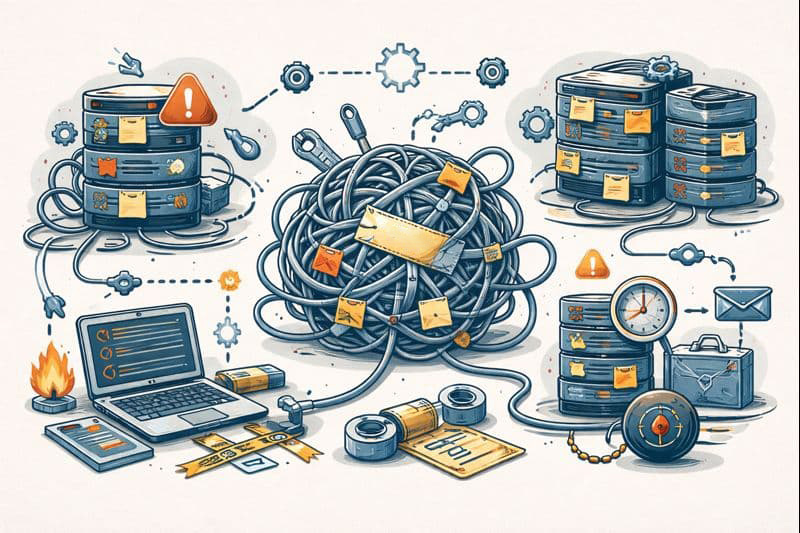
Every month adds more patches, more exceptions, and more hidden rules until maintenance feels like defusing a bomb.
Mini conclusion up front:
Yes, the root cause is often planted during design, especially when behavior is not bounded and decisions are not observable.
Maintenance gets harder because hidden complexity accumulates faster than your team can reason about it.
You reverse the trend by designing constraints, making execution paths visible, and treating operational feedback as part of the product.
This article solves one specific problem: why automation becomes harder to maintain as it runs longer, which design choices cause the decay, and what practical patterns beginners can copy to keep systems maintainable.
1. Maintenance Gets Harder Because Complexity Compounds Quietly
1.1 Automation Rarely Becomes Unmaintainable Overnight
Automation almost never becomes unmaintainable in one dramatic moment.
It becomes unmaintainable in layers.
Typical layer growth:
- a special case for one target
- a workaround for one node type
- a retry exception for one endpoint
- a fallback that never turns off
- a scheduler rule nobody remembers adding
Each layer is rational in the moment.
Together, they create a system nobody can fully explain.
The result:
- bugs feel random
- performance feels unpredictable
- fixes cause side effects
- new teammates cannot build intuition
2. The Root Cause Often Starts in Design, Not in Operations
2.1 Unbounded Behavior Creates Infinite Edge Cases
If an automated system has no hard boundaries, it will eventually explore every edge case in the world.
Examples of unbounded behavior:
- unlimited retries
- unlimited concurrency growth
- unlimited route switching
- unlimited node rotation
- unlimited session resets
These settings seem helpful early because they keep tasks alive.
Later, they destroy maintainability because behavior becomes impossible to predict.
Beginner rule you can copy:
Every automatic action must have a budget.
- retries need a cap
- fallbacks need a cooldown
- switching needs a per task limit
2.2 Hidden Decision Logic Creates Mystery Failures
Many automation engines make decisions silently:
- which node was selected
- why a path was avoided
- why pacing slowed down
- why a fallback engaged
- why a task was deprioritized
When decisions are invisible, every incident becomes detective work.
Teams argue about causes because nobody can prove the decision chain.
Maintainability requires that decisions leave footprints.
2.3 Coupling Between Stages Turns Small Changes Into Cascades
Automation systems often couple stages too tightly:
- scheduler settings affect retry density
- retry density affects queue pressure
- queue pressure affects latency
- latency triggers timeouts
- timeouts trigger more retries
This is a feedback loop system.
If you change one knob, you change the whole ecosystem.
Designs that do not isolate stages will always be hard to maintain.
3. Why Systems Degrade Even If the Code Does Not Change
3.1 The Environment Changes Constantly
Targets change structure.
Networks change routing.
Node pools change health.
Traffic patterns shift.
Dependencies evolve.
Automation interacts with a moving world.
If your system assumes a static world, maintenance load will increase over time.
3.2 Quick Fixes Accumulate as Permanent Policy
A common maintenance trap:
- an incident happens
- a quick patch is applied
- the patch is never revisited
After enough incidents, you have:
- a rule for every past problem
- no coherent strategy
- no clear removal plan
This is how systems become policy junkyards.
4. Three Hidden Sources of Maintenance Pain
4.1 Lack of Constraints
If behavior is not constrained, debugging is not finite.
You cannot reproduce issues because the system can behave differently each run.
4.2 Lack of Observability
If execution is not visible, fixes are guesses.
Guessing produces patches.
Patches produce more complexity.
4.3 Lack of Ownership Boundaries
If nobody owns specific components clearly, every change becomes unsafe.
Schedulers, node pools, retry logic, fallback logic all need clear ownership and contracts.
5. A Practical Maintainability Pattern Beginners Can Copy
5.1 Define a Contract for Each Stage
- scheduler decides concurrency
- router decides path choice
- executor performs requests
- retry manager handles failures
- observer records decisions
5.2 Add Budgets That Bound Behavior
- max retries per task
- max route switches per task
- max concurrency per node
- max fallback duration before review
5.3 Record Every Decision That Changes Outcomes
Log the why, not just the what:
- why a node was chosen
- why fallback engaged
- why pacing changed
- why retries happened
5.4 Add Periodic Cleanup
- flag rules added as emergency patches
- review them on a schedule
- remove or rewrite them into coherent policy
This pattern keeps automation from becoming a patch pile.
6. Where CloudBypass API Fits Naturally
CloudBypass API helps maintenance by giving teams visibility into behavior drift that usually stays hidden.
It can surface:
- node health trends over long runs
- route variance that explains random incidents
- phase timing drift that predicts upcoming instability
- retry clusters that signal a policy problem
- fallback frequency that indicates an unhealthy strategy layer
Because it exposes these signals clearly, teams spend less time arguing about what happened and more time fixing the right component.
CloudBypass API fits best when you want your automation to be maintainable at scale, not only functional today.
7. A Simple Maintenance Checklist You Can Apply Immediately
- if you cannot explain why a decision happened, log it
- if a behavior can expand forever, budget it
- if a rule was added in a crisis, schedule its review
- if a stage influences too many other stages, isolate it
- if stability depends on tribal knowledge, convert it into observable signals
Automated systems become harder to maintain because complexity compounds, the world changes, and unconstrained behavior creates infinite edge cases.
In many cases, the root cause is planted during design: invisible decisions, tight coupling, and lack of budgets.
You keep automation maintainable by designing constraints, recording decision chains, and continuously cleaning up emergency rules.
The goal is not a system that runs forever without change.
The goal is a system you can change safely, even after it has been running for a long time.